Reading / 02 / Error correction
Room for
a correction
Sometimes information becomes more dependable when it carries more than the minimum needed to express a value.
An educational technology note.
01Information with a little extra
A stored or transmitted value can change unintentionally. Error-correcting codes add structured redundancy: extra information calculated from the original data. A reader can use the relationship between the data and the extra information to detect, and in some cases correct, a change.
This is different from simply keeping a second complete copy. The additional information is organized around a code with particular capabilities. The code determines which patterns of errors can be recognized and which can be repaired.
Hypothetical teaching example
A vote between three copies
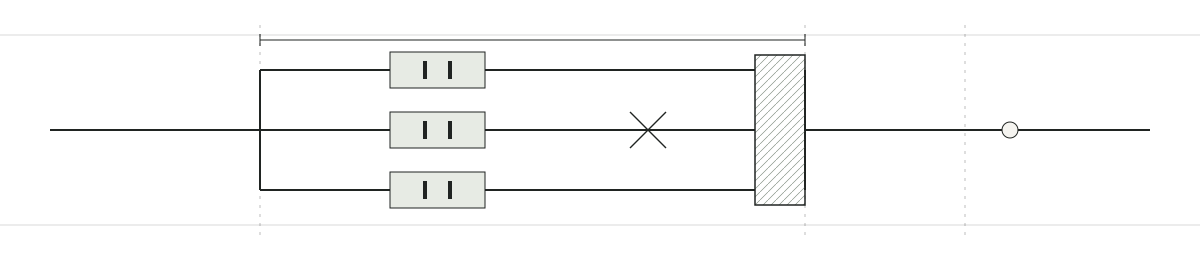
Suppose a toy system represents one bit by writing it three times. A one becomes 111 and a zero becomes 000. If 111 arrives as 101, a majority vote would interpret the result as one.
The model can recover from one changed position in that group. If two positions change, the majority can point to the wrong original value. The extra copies help only within a stated assumption about the errors.
Real error-correcting systems commonly use more efficient mathematical arrangements. This example illustrates redundancy, not the internal design of a particular memory product.
02Detection is not correction
A check can show that a value does not satisfy an expected relationship without revealing where the mistake occurred. Correction needs enough additional structure to distinguish between possible originals. The difference matters whenever a feature is described only as having “error checking.”
Memory is one practical setting. ECC memory uses additional checking information to address certain bit errors. Its protection depends on the code and on the memory system that implements it. A capability inside a memory chip does not automatically describe protection across the entire path to a processor. Micron’s ECC memory overview provides further context.
03Ask what the protection covers
Useful questions include where a check is applied, which errors it can recognize, what happens when correction is impossible and whether an error is reported. These questions reveal more than the presence of a reassuring acronym.
Error correction also has a boundary: it cannot decide whether correctly stored information was sensible in the first place. Nor does it replace a backup after an intended deletion. Reliable information depends on several distinct protections, each addressing a different kind of failure.
These concepts describe technology in general. They do not describe activities or services of STYLECRAFT PLUS LLC.